
By Phil Irwin, LUTCF, CLCS · Gold Insurance Solutions · Wildfire Country Home Insurance Experts
If you own a home in California wildfire country, the Wildfire Prepared Home designation is worth knowing about. It’s a third-party certificate from the Insurance Institute for Business & Home Safety (IBHS) that documents your home has been hardened against embers and flames. Whether you live in Folsom, El Dorado Hills or Granite Bay, up in the Sierra foothills and Gold Country, or out in Napa, Sonoma and Lake counties, here’s what the designation requires, what it costs, how long it lasts, and how it fits with California’s insurance discount rules.
What is the IBHS Wildfire Prepared Home designation?
IBHS launched Wildfire Prepared Home in June 2022 and opened it to single-family homeowners in California. It focuses on three areas: the roof, key building features, and defensible space, including the 0–5 foot zone right around the house.
There are two levels:
- Wildfire Prepared Home (Base) focuses on embers.
- Wildfire Prepared Home Plus adds protection against flames and radiant heat.
On its FAQ page, IBHS now calls these levels Essential (formerly Base) and Enhanced (formerly Plus). The requirements didn’t change, just the names. Most existing homes start at the first level.
What does a Wildfire Prepared Home require?
These come from the IBHS 2026 abbreviated checklist. Every item must be done.
Roof
- A Class A fire-rated roof covering, such as asphalt shingles, tile, slate or metal.
- Noncombustible gutters and downspouts, kept clear of leaves and needles.
Building features
- Ember-resistant vents, or existing roof, attic, eave and foundation vents covered with 1/8-inch corrosion-resistant metal mesh. Dryer vents need a working louver or flap, with no mesh.
- 6 inches of noncombustible material (siding or exposed concrete foundation) at the base of exterior walls and above attached decks or patios.
Defensible space
- A 5-foot noncombustible zone around the home: no vegetation, mulch, overhanging branches or combustible items. Wood or vinyl fencing within 5 feet must be replaced with noncombustible fencing such as metal.
- 5 to 30 feet: properly spaced trees and shrubs, trimmed grass, dead vegetation removed, and firewood stored at least 30 feet away.
- Detached structures: no more than 3 within 30 feet of the home, each properly placed and surrounded by noncombustible materials.
Our guides to Zone Zero in California and ladder fuels and defensible space walk through this work.
What Wildfire Prepared Home Plus adds
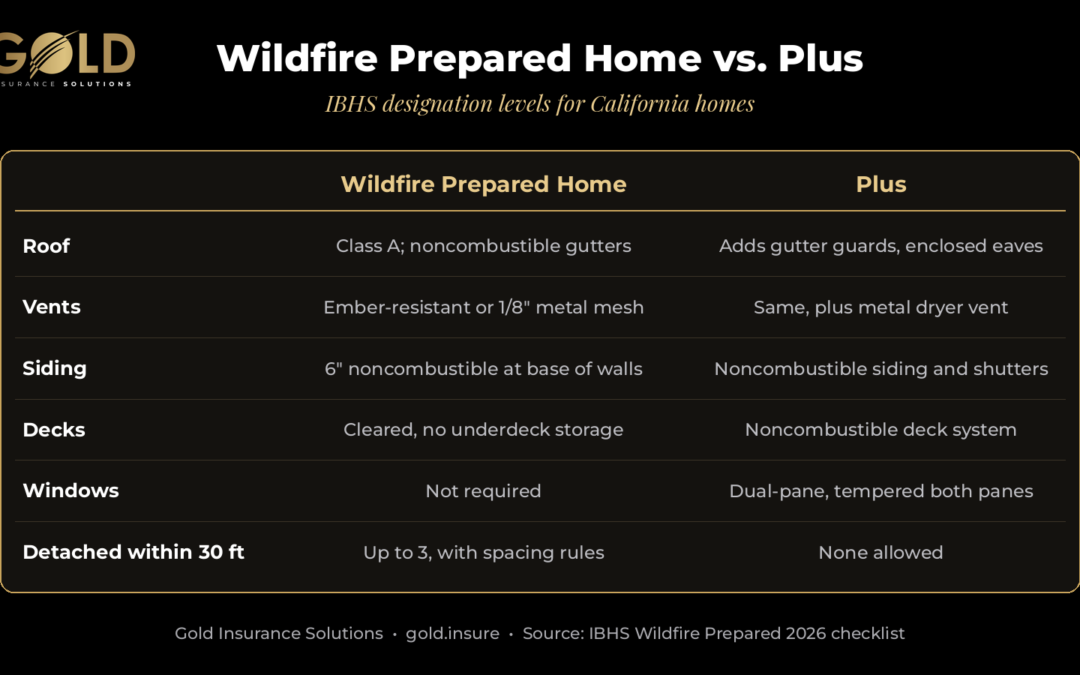
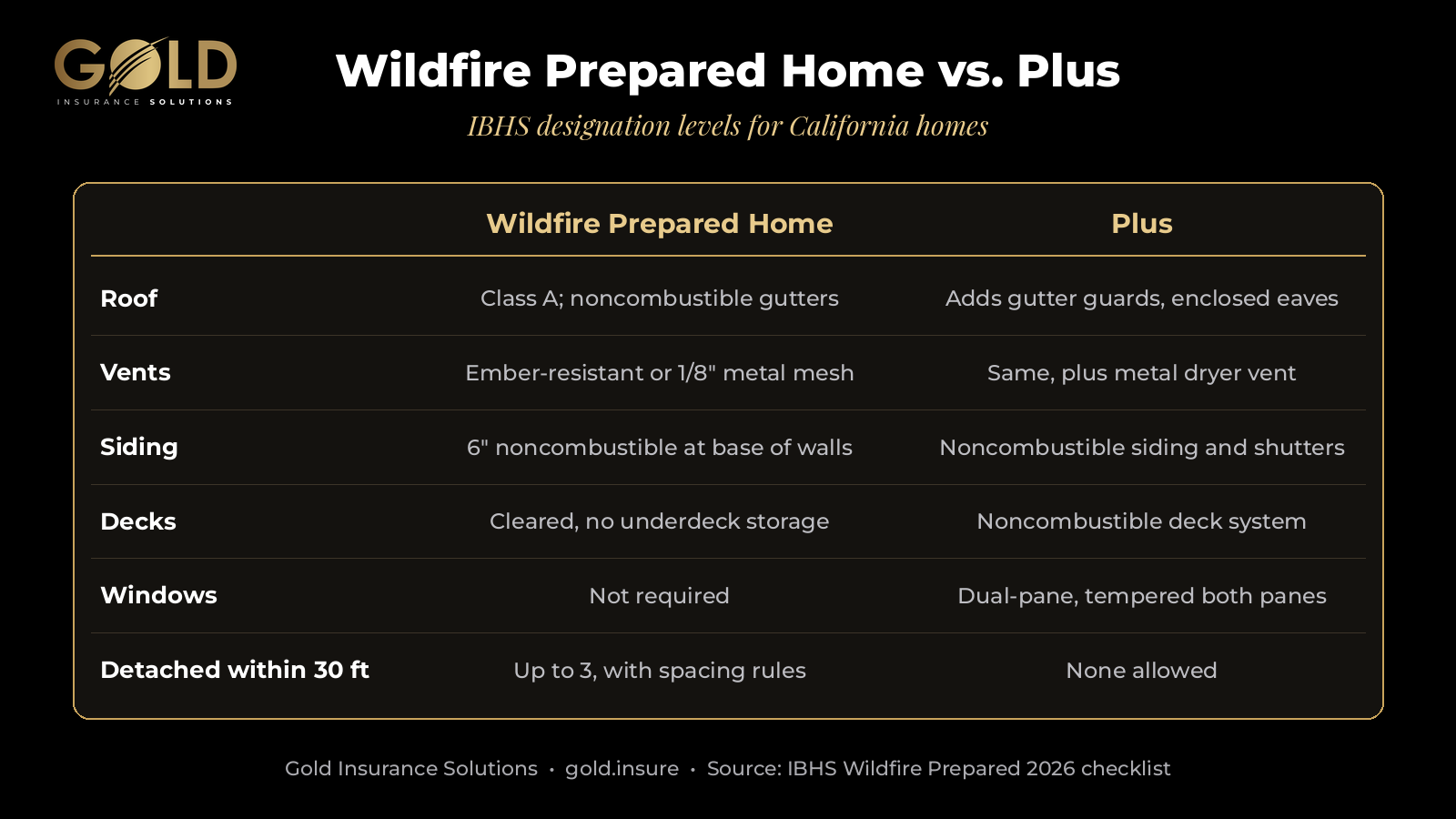
Plus includes everything above, then adds:
- Noncombustible gutter guards and enclosed eaves (noncombustible soffit and fascia).
- Noncombustible siding and shutters in place of vinyl, wood or engineered wood.
- A noncombustible deck system, such as steel joists, concrete, tile, stone or pavers.
- Dual-pane windows with tempered glass in both panes.
- No detached structures within 30 feet of the home.
Who is eligible?
According to the IBHS FAQ, eligible homes include single-family detached homes, modular homes, and HUD-Code manufactured homes built after July 1994. The home must be on a permanent foundation, three stories or fewer, and may not be eligible if the 5-foot noncombustible zone can’t be met.
How to apply, and what it costs
The application fee is $125, nonrefundable, and paid when you apply, according to IBHS’s Apply for an Inspection page. Mitigation costs are separate and depend on the condition of your home.
For a sense of scale, a California Department of Insurance briefing from March 2026 cited Headwaters Economics/IBHS estimates for a new $500,000 home in Altadena: about $9,000 in added cost to build to the Base level and about $15,000 for Plus. Retrofit costs vary, so get local bids.
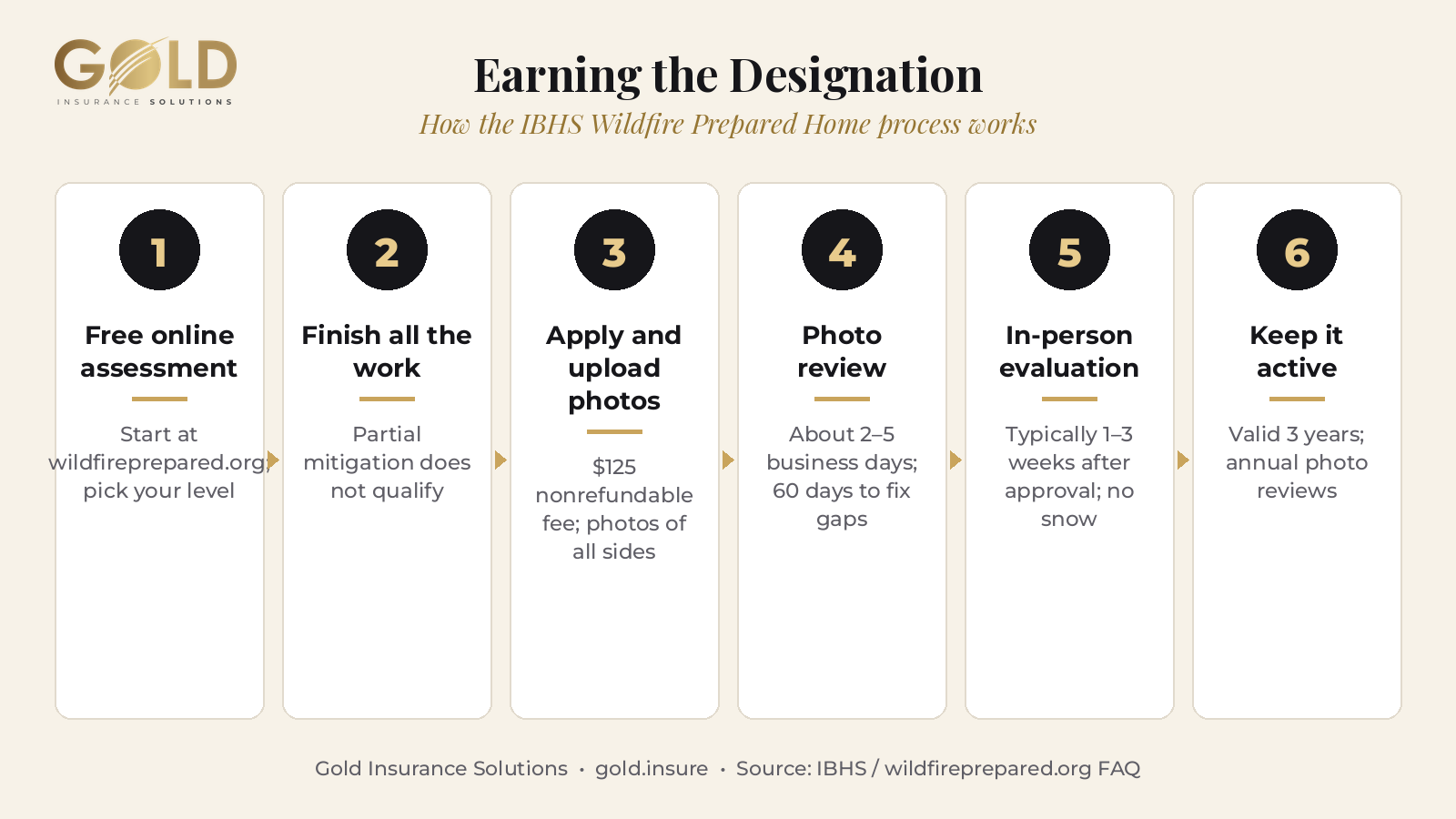
Here’s the IBHS process:
- Start with the free online assessment at wildfireprepared.org and download the checklist for your level.
- Finish all the work first. IBHS says partial mitigation doesn’t qualify.
- Apply, pay the fee and upload photos of all sides of the home, key features and the 0–5 foot zone.
- Photo review takes about 2–5 business days. If something is missing, you have 60 days to fix it and resubmit.
- In-person evaluation is typically scheduled 1–3 weeks after you’re approved. No evaluations happen with snow on the ground, a factor for higher homes in Nevada, Placer and El Dorado counties.
- Final audit takes about 2–5 business days.
Plan on several weeks to a few months from start to finish.
How long does the designation last?
The designation is valid for three years. To keep it active, complete a photo-based annual review after year one and in year two. Adding combustible materials inside the 5-foot zone can put your status at risk.
The designation stays with the property; a new owner can request a transfer for a small fee.
Safer from Wildfires: what California requires of insurers
California’s mitigation discount rule is 10 CCR § 2644.9, operative October 14, 2022, and part of the Department of Insurance’s Safer from Wildfires framework. Insurers’ rating plans must reflect the reduced risk from these mandatory mitigation factors:
- Building hardening: Class A fire-rated roof, enclosed eaves, fire-resistant vents, multipane windows or functional shutters, and 6 inches of noncombustible vertical clearance at the base of exterior walls.
- Immediate surroundings: clearing within 5 feet of the building, noncombustible fences and gates within 5 feet, clearing under decks, removing combustible structures within 30 feet, and complying with state defensible space law.
- Community programs: a Firewise USA site in good standing, or a Fire Risk Reduction Community listed by the Board of Forestry.
The Department’s September 2026 FAQ for insurers says rating plans must include a separate discount or credit for each mandatory factor, and insurers may give larger discounts for combinations of factors. Insurers must accept CAL FIRE or local fire department inspections as proof, not just a certificate.
The regulation doesn’t name the IBHS designation. But Wildfire Prepared Home covers nearly every mandatory home-level factor, and the certificate independently documents the work. IBHS also notes that insurance discounts are not guaranteed and vary by insurer.
Your rights as a California policyholder
Under the regulation, your insurer must give you a wildfire risk score within 15 days of a completed application and at least 45 days before renewal. After you finish a mitigation project, you can request an updated score, due within 30 days. You can appeal a score you believe is wrong. The Department’s consumer FAQ says savings apply at the start of your next policy period, so let your insurer know when work is done. For more, see our guide to California wildfire mitigation discounts.
How we help: the Wildfire Insurability Walk-Through
The best step before you apply for Wildfire Prepared Home is our free, in-person Wildfire Insurability Walk-Through. We walk the outside of your home through each carrier’s underwriting lens, identify the mitigation priorities that matter most, and help you plan for them, so you don’t spend $125 on an application that comes back with a list of fixes. We also validate hardening you’ve already done.
The Walk-Through helps you determine if your home qualifies for Mercury, our top carrier in the California home insurance market. If it doesn’t, we shop our other admitted carriers. For buyers and Realtors, doing this before the offer helps avoid escrow surprises.
Book a free Wildfire Insurability Walk-Through: calendly.com/phil_irwin_availability/30min · Get a free home quote: gold.insure/quote · Realtors: send quote requests to quote@gold.insure
Frequently asked questions
How much does the Wildfire Prepared Home designation cost?
The IBHS application fee is $125 and nonrefundable. The cost of the mitigation work itself is separate and depends on your home.
How long does a Wildfire Prepared Home designation last?
Three years. You must complete a photo-based annual review after year one and in year two to keep it active.
What’s the difference between Wildfire Prepared Home and Wildfire Prepared Home Plus?
The Base level focuses on ember protection: Class A roof, ember-resistant vents, a 5-foot noncombustible zone and more. Plus adds flame and radiant heat protection, such as noncombustible siding and decks, tempered dual-pane windows and no detached structures within 30 feet. IBHS now calls them Essential and Enhanced.
Will a Wildfire Prepared Home designation lower my insurance premium?
It may. California requires insurers to offer discounts for specific mitigation actions, many of which the designation covers, but discounts aren’t guaranteed and vary by carrier.
Do I need the IBHS certificate to get Safer from Wildfires discounts?
Not necessarily. The Department of Insurance says insurers can’t limit verification to a certificate and must accept CAL FIRE or local fire department inspections. The designation is one strong way to document your work.
Should I get a Wildfire Insurability Walk-Through before applying?
We recommend it. Our free walk-through flags what still needs work, so your application and insurance shopping go more smoothly.
Phil Irwin, LUTCF, CLCS, is President of Gold Insurance Solutions in El Dorado Hills, with more than 30 years in insurance. CA License #0G50873 · Agency License #6000540. This article is general information, not a guarantee of coverage, eligibility or discounts.
Sources: IBHS: Wildfire Prepared Home Launches · Wildfire Prepared: FAQ / Eligibility & Program Rules · Wildfire Prepared: 2026 Abbreviated Checklist · Wildfire Prepared: Apply for an Inspection · CDI: Wildfire Safety and Insurability Briefing (March 2026) · CDI: Safer from Wildfires Consumer FAQ · CDI: FAQ on Mitigation in Rating Plans (Sept. 4, 2026) · 10 CCR § 2644.9